
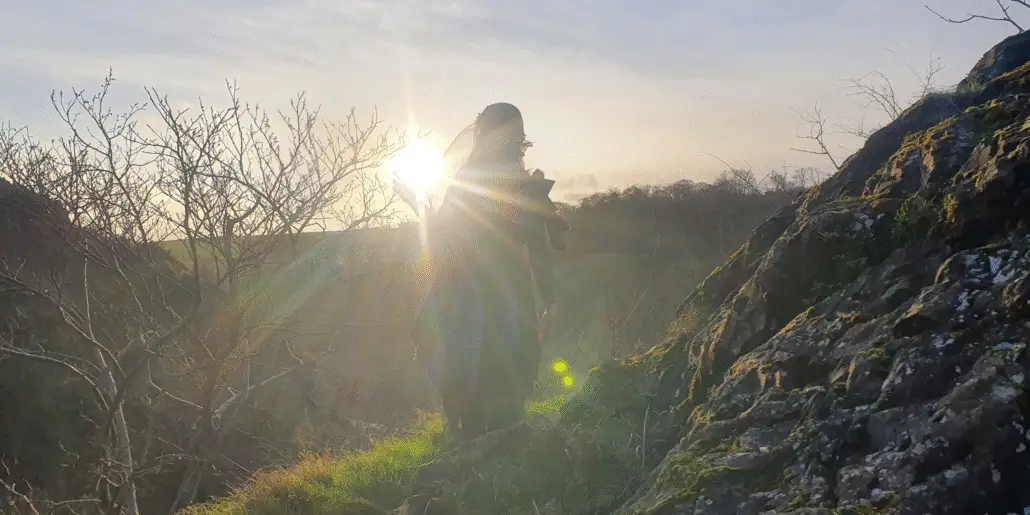
The Lore of the Cailleach
I must admit, I had never heard this creation story of Scotland until I was into my forties. Until then, I had no idea what our creation story may be. I love this story. The strength of one woman, the determination and the lore all wrap into somethingr really rather beautiful. I admit, the story of the Cailleach may feel like a myth wrapped in mist and mountain, but it’s also a thread that runs through real landscapes, ancient belief systems, seasonal patterns, and sustainability lessons still relevant today. While she may be a creature of folklore, the Cailleach is deeply rooted in Scotland’s cultural and environmental story.
The Cailleach in Myth and History
The word Cailleach (pronounced kall-yach, with that soft Scottish ‘ch’) simply means “old woman” or “hag” in Gaelic, but that barely scratches the surface. She is known across Celtic cultures, with different names and qualities depending on the region. In Scotland, she is often seen as a goddess of winter, weather, and the land itself; powerful, wild, and untamed.
Some sources trace her name to the early Celtic and pre-Celtic goddess traditions, linking her to sovereignty and creation myths. She appears in the folklore of Ireland, Scotland, and the Isle of Man, and sometimes even beyond, in echoes of similar land-shaping female figures in Norse and Breton lore. She harks back to a time when woman were believed to have strength and could just as easily be a god as a man. Some even suggest socity may have been matriarchial when this story originated.
She’s not always kind, but she’s not evil either. The Cailleach is a force of nature; essential, enduring, and sometimes harsh. Her stories help explain why the weather is wild, why winter overstays its welcome, and why certain mountains hold a sense of ancient mystery.
Real Places, Real Connections
The Cailleach has roots in real places in Scotland
Ben Cruachan, often said to be the mountain where she sleeps, is known locally as the Mountain of the Cailleach. It’s near Loch Awe, a place steeped in stories.
Beinn na Caillich (the Hill of the Old Woman) appears in Skye and other places, showing how widespread her story is.
Loch Awe, Glen Lyon, and Rannoch Moor all have associations with her, and they hold signs of ancient human life: standing stones, burial cairns, and sacred sites. I particulary love the link she has with Glen Lyon.
In Glen Lyon, there’s a centuries-old tradition involving three carved stones, one representing the Cailleach (the old woman of winter) and the other the Bodach (the old man, her consort), and a smaller one, Nighean na Cailliche, their daughter. These stones are kept in a small turf-roofed house up in the glen.
Each year, according to oral tradition, an unknown local would “bring them out” at the start of winter, placing them in a way that suggests they were returning to the landscape. Then in spring, they were “put to bed” again, carefully tucked away.
These places aren’t just poetic settings. They are reminders that ancient people didn’t separate their stories from their surroundings, and, that the stories are alive in the landscape today.
Science Hidden in the Story
While the Cailleach creates mountains and carves rivers with her staff in myth, the geology of Scotland tells a story just as dramatic.
Scotland’s rugged landscape formed over millions of years, shaped by tectonic plate movement, ancient volcanoes, and ice age glaciers. (you can read more about this in a blog here)
Glaciation carved out the glens and lochs that are central to Cailleach lore, places like Rannoch Moor and Loch Lomond are textbook examples of glacial shaping.
Her staff splitting the land? That’s a perfect metaphor for fault lines and shifting earth.
The “spilled stones” across Rannoch Moor? They could easily represent erratics – large boulders transported and deposited by glaciers.
These stories weren’t primitive misunderstandings, they were early ways of making sense of the land. And today, they still help us connect emotionally and imaginatively to the science behind Scotland’s striking terrain. My husband has a better understanding of geography and geology than I. Often, as we explore Scotlamd, I will ask why a landscape is the way it is. Why there is a sudden boulder or hillock. Why the mountains are shaped as they are. Why the west coast feels so different to the east. These questions have been asked for millenia.
Seasonal Cycles and Sustainability
At her heart, the Cailleach represents the seasons. She brings winter and withdraws when spring comes. In some tales, she battles or hands over power to Brigid, the goddess of spring. This seasonal passing of power reflects the turning of the year, and our relationship with the land.
Folklore like this offers us more than just stories; it reminds us of ways of living that we have, in many cases, forgotten. It speaks of seasonal rhythms that were once deeply respected and essential for survival. It highlights the importance of rest and retreat, like the Cailleach’s winter slumber, something we have truly lost sight of as a society. It shows us the power and fragility of nature, where storms and snow are just as necessary as sunshine. And it reminds us of our need to live with the land, not against it.
Powerful Women in the Beginning: Stories That Shaped the World
The Cailleach is not alone.
Across cultures, across time, women, or beings that are part woman, part something more, have stood at the centre of creation stories. They shaped lands, birthed worlds, gave language and rhythm to life. Their names might differ, their landscapes might be oceans, deserts, or mountains, but their power is shared. They were creators, shapers, bringers of balance, not side characters or helpers, but forces in their own right.
These stories are ancient. But their lessons are more relevant than ever. Some of them include:
Papatūānuku (Aotearoa/New Zealand)
The Māori earth mother. Together with Ranginui (the sky father), her embrace formed the world. She is land, nourishment, growth, and she is still honoured in Māori ceremony, education, and environmental care.Sedna (Inuit peoples)
A sea goddess whose fingers, when cut off, became seals and whales. She is both feared and revered, and her story carries deep lessons about respect, responsibility, and balance between human and animal.Ninhursag (Sumerian)
One of the earliest written creation goddesses, she shaped the first humans from clay. Her name means Lady of the Sacred Mountain. She was called the “mother of all living.”Spider Woman (Hopi/Navajo)
A weaver of life and worlds, she brings humans into being and teaches them how to live with the land. She appears in dreams and rituals, a figure of quiet, guiding strength.Gaia (Greek)
The original mother, Earth herself. From her came sky, sea, and the Titans. In modern environmentalism, her name resurfaces in the Gaia hypothesis, reminding us that Earth is alive and interconnected.Mbaba Mwana Waresa (Zulu)
A goddess of rain, fertility, and the harvest, she also taught humans to brew beer, a powerful symbol of culture and community. She ruled over balance, not domination.
Why These Stories Matter Now
We live in a time where many young people are grappling with dangerous messages, especially about gender. Misogyny, fuelled by social media algorithms and toxic influencers, is creeping into classrooms and conversations. Girls are reporting increased harassment. Boys are being fed scripts that equate dominance with strength.
And yet, here are these stories, older than patriarchy, where women were the world-builders. The land-shapers. The ones who gave language, light, and law.
What does it mean for a child to learn that the land they walk on was shaped by a woman?
That the sky, the sea, the trees, all came from her hands?
What does it mean for a class to hear that power can be gentle, creative, and sustaining, not loud, controlling, or cruel?
Folklore as Resistance and Rebalance
When we tell these stories, we don’t just share myth, we challenge the narratives that children absorb every day. We show that women have always had power, and we introduce girls to role models older than textbooks. We remind boys that strength comes in many forms and that balance is just as important as bravery. We offer teachers gentle tools to begin conversations that feel safe, yet lead to deep reflection. And perhaps most importantly, we plant the idea that stories shape beliefs, and beliefs shape behaviour.
In an age where some voices try to erase or diminish women’s place in the world, these stories return us to the truth: women were never secondary. They were creators. Protectors. Sustainers.
And they still are.
But more than that, her story can help us slow down, reconnect, and reimagine education that speaks not just to facts, but to feelings, belonging, and place.