Recently, while reading Sharon Blackie’s Hagitude, I found myself completely captivated by her reflections on place, time, and the stories etched into the land. One line had me pause, put the book down, and open up a geological map of Scotland. She reflected on how the rock we live on, whether the hardest of old rock like the Lewis gneiss or the sedimentary rocks like sandstone in the Cambrian Mountains of Wales impacts what type of person she might be. I wondered what that would mean for me, but to know that I needed to know one key thing. What kind of rock is my home built upon?
But, if I’m honest, this curiosity didn’t come from nowhere.
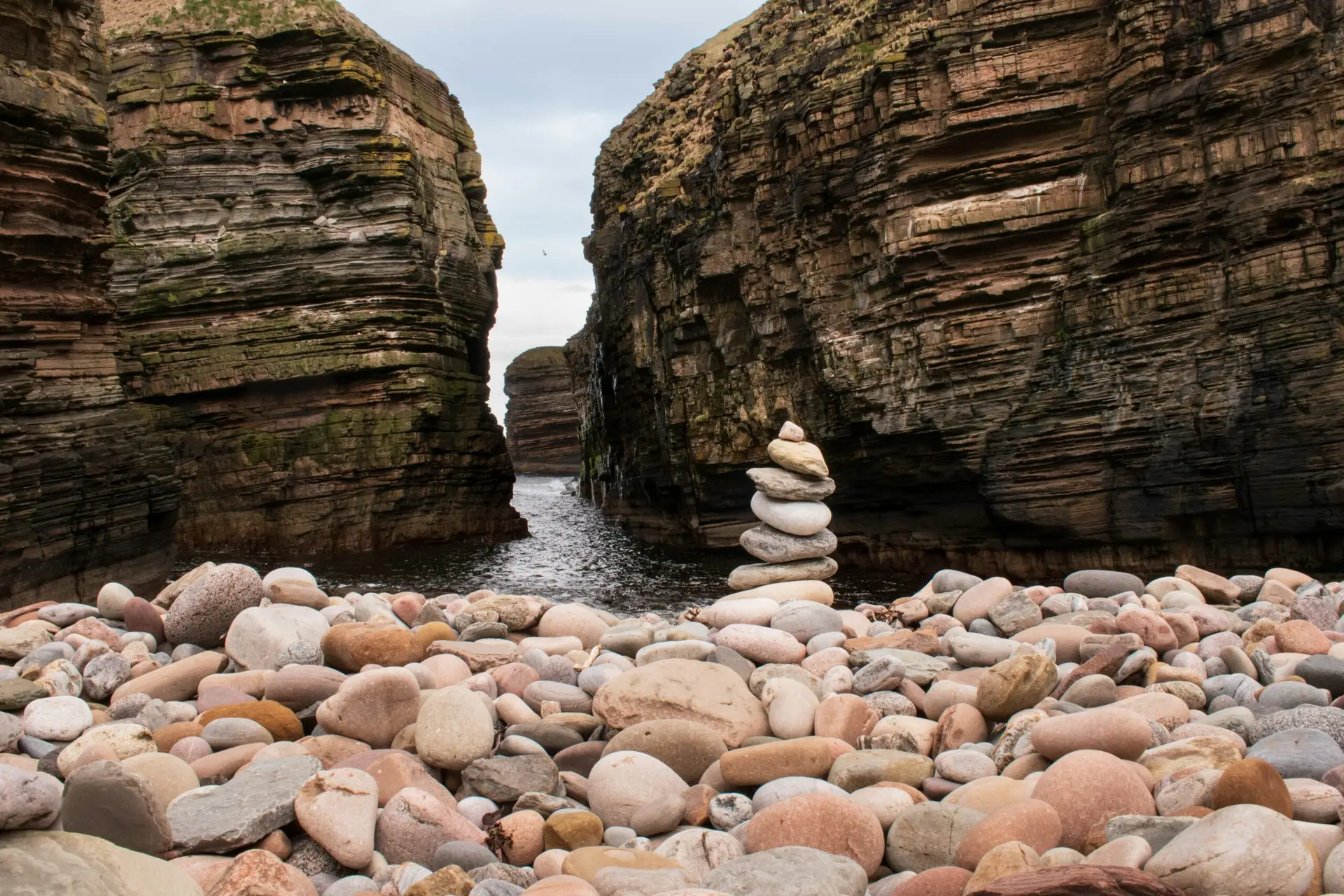
The first time I really thought about bedrock and considered what lies beneath our feet was during my Master’s in Learning for Sustainability. I was on a field visit to Millport, the small island off the west coast of Scotland in the Firth of Clyde. The bedrock here is so interesting! There is a rich mix of sedimentary and volcanic formations, dating back over 350 to 400 million years. You can see layers of ancient riverbeds, evidence of long-extinct volcanoes, and even the marks left by glaciers that once scoured the island. Millport may be a wee island, but the rocks there are so rich in history. You can literally see it!
I was struck by how the very rock beneath us influenced the shape of the coastline, the richness of the marine life, and even the type of learning that could happen in that place.
It was the first time I’d seen bedrock not as something hidden and scientific, but as something living, something that anchors us, shapes our surroundings, and connects us to deep time.
So, when Hagitude nudged me to look again at my own landscape, that long ago spark reignited.
What Is the Rock Beneath Me?
Curiosity piqued, I went digging, figuratively, this time to uncover what this meant. When I looked up the geology of my area, I was told I am on the Midland Valley Sill complex Igneous bedrock formed during the Carboniferous period. But, I had no idea what that meant so I had to take some time to break it down.
The first thing I learned was that I have spent most of my life in an area which is called the Midland Valley Sill. It stretches from Glasgow to Edinburgh and Falkirk to Stirling. It’s known for its rich geological history and was once a rift valley (a sort of land that’s sunk between two faults). It was formed 300 million years ago during the Carboniferous period.
I knew once upon a time the area was dominated by volcanoes, from the one Edinburgh Castle sits on to the more local Knock Hill and Cockleroy, where you can see evidence of this in the landscape. The land was created by molten magma, but not lava flowing over the land. Instead, it was bubbling and shifting deep beneath the earth’s surface before it cooled into solid rock. This wasn’t a surface lava flow it was something different. A sill forms when magma squeezes between older rock layers underground, like warm jam in a rock layered sandwich before hardening.
It’s described as a complex sill because it’s not made from just one type of magma. Instead, it tells a longer story, one of different kinds of molten rock pushing through at different times, hardening in layers, forming an intricate record of fiery upheaval and slow transformation. It wasn’t a one off event but a series.
But here’s the part that really made me stop and breathe it all in when this rock was forming, Scotland wasn’t even where it is now. During the Carboniferous period, the land I now live on was much closer to the equator, part of a hot, humid, tropical environment filled with swamp forests. Volcanoes rumbled beneath the surface, great ferns and giant horsetails towered above it, and early amphibians crawled across the forest floor. All of that was happening above while the molten rock below shaped what would eventually become the bedrock of central Scotland.
Over hundreds of millions of years, layers of earth wore away, and now this once hidden sill lies just below the surface supporting homes, gardens, schools, and lives. (and causing more than one broken spade in my garden!)
And somehow, knowing that has changed the way I look at the place I live. The land is no longer just a surface, it’s a story.
What About Other Places?
Scotland is a treasure trove of geological diversity. In the Highlands, you’ll find Lewisian gneiss, some of the oldest rocks in Europe, dating back over 3 billion years, older than the hills, quite literally. The Cairngorms are made of granite that cooled deep underground, while parts of Skye and Mull were shaped by volcanic activity, their dark basalt cliffs a testament to ancient lava flows. In contrast, southern Scotland and the Borders lean more toward sedimentary rocks like sandstone, formed from layers of ancient sea and riverbed deposits.
Elsewhere in the UK, you’ll find just as much variety. In Mochdre and Colwyn Bay in North Wales, the bedrock dates from the Ordovician and Silurian periods, around 440 to 490 million years ago, when the area was submerged under deep oceans. These rocks are rich in the fossils of ancient sea creatures. On the south coast, the White Cliffs of Dover are made of chalk, formed from the remains of tiny sea creatures when the area was a warm, shallow sea 100 million years ago.
Whether you’re in the Highlands, beside a Welsh beach, or walking over London’s river gravel, the land beneath your feet is whispering its own story, if you pause to listen.
Why Learn About the Rocks Beneath Us?
In outdoor learning, we often focus on what we can see, the trees, the sky, the flowers, the minibeasts. But beneath it all lies a powerful story of fire, pressure, time, and transformation.
- Rocks shape the landscape from the hills we climb to the soil we dig in.
- They influence what grows, how water moves, and even what animals and people can thrive.
- They remind us that learning doesn’t have to start with what’s new, it can start with what’s ancient.
There’s something grounding (pun intended) about telling children that the rock beneath their feet was once magma, and that their playground sits on a 300-million-year old time capsule.
Inspiring Outdoor Learning Through Geology
You don’t need to be a geologist to bring this into your outdoor learning. Here are a few simple ways to help children connect to the ground beneath them:
1. Local Rock Hunts
Let learners collect small stones or rock fragments. Are they smooth or rough? Heavy or light? What colours and patterns can they find?
2. Mapping Our Foundations
Use an online geological map to explore what kind of rock lies beneath your school, home, or favourite outdoor space. What does that tell us about the past?
3. Storytelling Through Stone
Scotland is full of legends about giants shaping hills, or magical stones that walk. Let children invent their own tales based on the rocks around them. Or tell them the story of the Cailleach. The Cailleach is an ancient Scottish goddess and giantess, often known as the Hag of Winter. In folklore, she is said to have shaped the landscape of Scotland by dropping rocks from her creel as she strode across the land, forming mountains, hills, and lochs. With her staff, she could freeze the ground and bring snow, ruling over the winter months before handing power to Brìde (or Brigid) in spring. She is Scotland’s formation story.
4. Creative Time Travel
Encourage learners to imagine the landscape when their local rock was forming. What creatures were alive? What did the sky look like? Where was Scotland then?
5. Art, Music, and Movement
Create rock rubbings, stone mandalas, or dances that show the flow of lava. Make geology emotional, physical, and creative.
Curiosity to Connection
That one spark, a line in Hagitude, a memory from Millport, a search on a geological map reminded me just how rich learning becomes when we let the land lead.
We’re not just teaching children about rocks, we’re giving them a sense of place, a connection to deep time, and a feeling of wonder. Outdoor learning isn’t being outsides. It’s about understanding that the outside is alive with history, story, and meaning.
So next time you’re outdoors, don’t just look up. Look down. Because beneath your feet, there might be something incredible. A volcano, an ancient sea, or the memory of a world long gone.
“What’s beneath your feet? Go find out and let the rocks tell their story. This geological map viewer is a great place to start.”