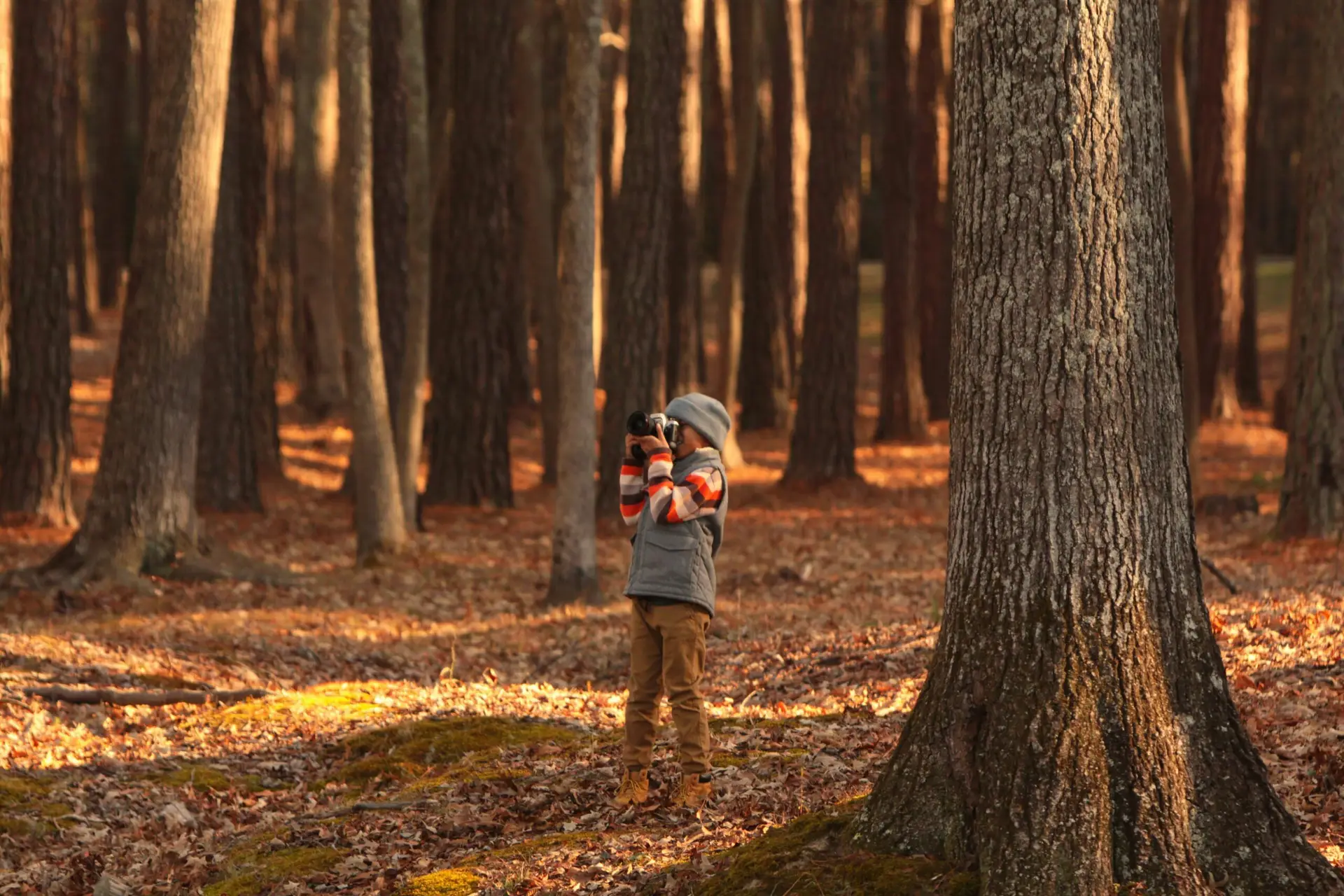
Celebrated every year on August 19th, World Photography Day is a perfect opportunity to inspire children to explore their surroundings, capture moments, and deepen their connection with nature and each other. Photography isn’t just about taking pictures—it’s about seeing the world differently, noticing details, and telling stories through images. By using photography as a tool, we can help children become more mindful of their environment, develop a sense of curiosity, and build meaningful connections with the world around them.
1. Nature Close-Up Challenge
Encourage children to get up close and personal with nature by taking detailed photos of small objects, such as leaves, flowers, tree bark, or insects. Provide them with simple tips on how to focus and frame their shots to highlight textures and patterns they might not normally notice.
Get Close: Encourage children to move closer to their subject to capture fine details like the rough bark of a tree or the delicate veins in a leaf.
Use Natural Light: Remind them to take photos in good natural light, preferably in the early morning or late afternoon when shadows are softer, as this enhances texture without harsh glare.
Try Different Angles: Ask them to experiment with angles—shooting from above, below, or even sideways—to find the most interesting perspective.
Fill the Frame: Suggest filling the entire frame with the subject, leaving little to no background, to focus solely on its texture or pattern.
Look for Repeating Patterns: Help them spot repeating patterns in nature, such as rows of petals, symmetrical leaves, or ripples in water, and frame their shot to emphasise the repetition.
Use Contrast: Encourage them to place contrasting textures or colours next to each other (e.g., a rough rock next to smooth moss) to make both elements stand out.
Keep Steady: Teach them to hold the camera or device steady or rest it on a stable surface to avoid blurring, which is especially important for close-up shots.
This promotes mindfulness and attention to detail and helps children see the beauty in the small, often overlooked elements of nature. It can even encourage curiosity about the natural world!
2. Photo Storytelling Walk
Take children on a photo walk, where they aim to tell a story through a series of pictures. Whether it’s documenting the life of a tree, following the path of a stream, or capturing the changing sky, encourage them to think about sequencing and narrative.
This is a fun way to explore story writing without using pen and paper. It encourages exploration and active engagement with the environment.
3. Wildlife Spotting Through the Lens
Give children the task of spotting and photographing different types of wildlife, from birds and insects to squirrels and butterflies. Provide them with simple wildlife identification sheets to help them name what they find.
This lesson helps build observation skills and an understanding of local biodiversity.
Children need to be patient to spot different wildlife, it is never there on demand after all.
Connection Tip: Use this activity to spark discussions about local wildlife and how we can protect their habitats.
4. Light and Shadow Play
Photography is all about capturing light, making the summer sun a perfect tool for creative exploration. Ask children to experiment with taking photos that play with light and shadow, whether through tree leaves, reflections on water, or silhouettes.
This encourages creative thinking and experimentation and helps children see their environment in a new way.
5. Seasonal Changes Time Capsule
Encourage children to take photos that capture the essence of the current season—from blooming flowers to buzzing bees. These photos can be compiled into a seasonal time capsule that they can revisit later in the year to see how their environment has changed. If they adopted a tree earlier in the year they could revisit this tree over the course of the seasons. Doing so builds an awareness of seasonal cycles and the passage of time and encourages reflection and long-term observation.
Additional Activities
- Colour hunt: Challenge children to find and photograph objects of different colours in nature.
- Symmetry search: Ask children to look for and capture examples of symmetry in the natural world.
- Mini photographers: Provide disposable cameras for younger children to explore photography in a simple, tactile way.
- Perspective swap: Encourage children to take photos from unusual perspectives—looking up at trees or down at the ground.
- Emotion in nature: Ask children to capture photos that represent different emotions using natural elements.
Why Photography Matters
Photography offers a unique way to help children slow down, observe, and engage more deeply with their environment. It teaches them to see beauty in the everyday, find joy in small moments, and express themselves creatively. On World Photography Day, we can use this powerful medium to foster connection—not only between children and nature but also among peers as they share their perspectives and stories.
This World Photography Day, let’s encourage children to pick up a camera and explore the world around them. Whether they’re capturing the delicate veins of a leaf, the playful dance of light and shadow, or the movement of a bee, each photo helps build a deeper connection to nature. Let’s inspire children to see through the lens of curiosity, creativity, and care.