When I started Love Outdoor Learning, I could never have anticipated the reach it would have. In this academic year we have had engagement from over 65 countries (which is a third of the countries in the world – did you know there are currently 195 recognised countries?). Three years ago, I received an email from a university called Slippery Rock in Pennsylvania. My first thought was this must be a wind up. But, after a little research, I discovered they are a very real and well-respected university.
Over the last couple of years, I have had the privilege of working with staff and students, sharing ideas around outdoor learning, metaskills, teacher development and learning beyond the classroom.
In the first year, I used my network to help design and coordinate a study abroad experience for their student teachers. They came over and visited Queen Margaret University, where I am a visiting lecturer. We gave them a tour of our campus and got them hands on with outdoor learning. After this, they spent the rest of their week viewing a residential centre and exploring the country.
Then year two came, and Dr Jeremy Lynch spent his sabbatical in Scotland. He was keen to undertake forest school training, but after listening to what he hoped to gain from this, we realised Wild Things Woodland Activity Leader Training would be a better fit. That’s the thing, I have personally undertaken most outdoor learning courses available in Scotland, which means I can recommend what fits the best. He also joined us for a Dirty Weekend Retreat. This is where educators from across the country, and often beyond, spend a weekend with me undertaking outdoor learning training and also having a chance to pause, to breathe and to reconnect with themselves and each other.
And connect they did! The teachers at this weekend welcomed Jeremy and plans were hatched, for a second student visit. This time, they would see more of Scottish education. The teachers offered Jeremy the opportunity for his students to spend a day with their classes. Jeremy and I also talked about how the training he had undertaken with me could benefit his students. A plan was made.
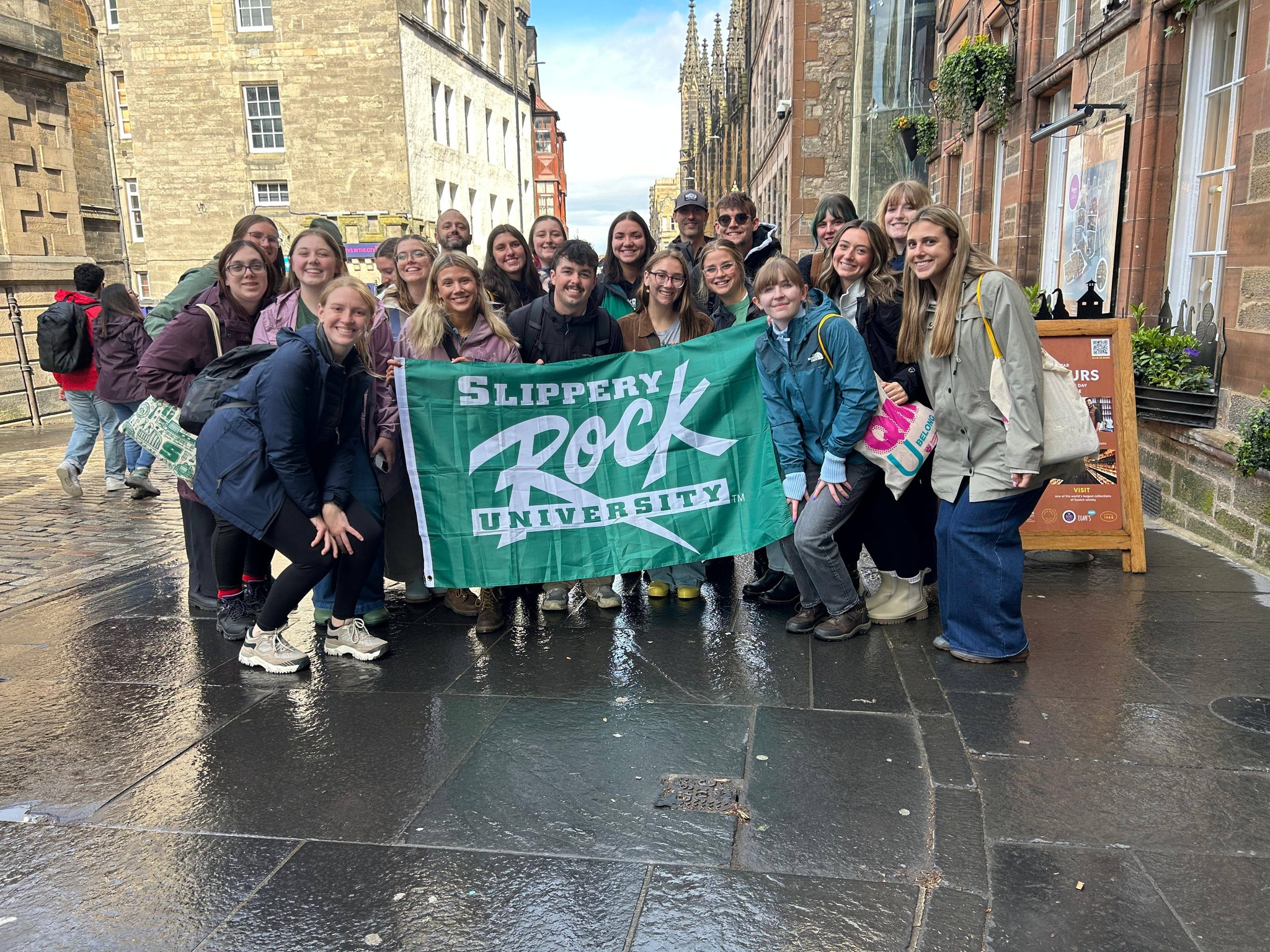
Year three arrived and what a year it has been. We had another group of twenty students come over with Dr Lynch and Dr Jason Hilton. This trip took months of planning, coordinating placements, arranging training, liaising with schools and nurseries, and ensuring students experienced the breadth of Scottish education. The visit combined school placements, outdoor learning training and experiential learning opportunities designed to support future educators. These were selected to highlight high quality outdoor learning but also the breadth of education in Scotland. Students went to council and private nurseries, state schools and independent schools, non-denominational schools and Catholic schools. All twenty students got to spend a day in a setting and see what high quality outdoor learning looks like on an every day basis. Having worked with over 400 primary schools in Scotland alone, we could pick and choose some of the highest quality outdoor learning I am aware of.
The feedback from students afterwards suggested this was one of the most valuable parts of the visit. Abby, who visited Little Monkeys Nursery, reflected:
“Visiting this school gave me a deeper understanding of the impact outdoor education can have on children and how I could possibly use it in the future.”
She was particularly struck by the positivity of the staff and how intentionally they created an encouraging environment for children. Morgan, who also visited Little Monkeys, described the programme as “absolutely fantastic” and spoke about hoping to incorporate some of the practices she observed into her own future classroom.
Some of the things that surprised them shocked me. Something as simple as a school walking to a community site, along main roads, was something that they had not seen before. Before we sent them out we had in depth conversations about risk, and how some of the things they would see would not be allowed in their state, but that did not mean they were unsafe. How we teach our children in Scotland to explore risk, teaching them to recognise it and mitigate it. That fires, tools, climbing trees, walking along the sidewalk, are all safe if we teach the children. And, that children in Scotland are not some weird species who inherently know how to keep themselves safe but instead, we simply teach it.
This was something several students commented on. Ina, who spent time at Cramond Primary, was surprised by the level of independence children were given outdoors. She noted:
“I was shocked that the students were taken down to the road to practice [Bikeability], as that would be unheard of in the US, but the children were all safe and behaved properly.”
She also commented that although children often had less direct supervision than she was used to seeing, they were clearly aware of their surroundings and the risks involved.
But we did so much more than just that, we also delivered two training days for the students. The first was at North Berwick, learning how to light fires with flint and steel, rock pooling, exploring giant art and measures and so much more. The second was in the grounds of Newbattle Abbey College, where they were staying. Here we explored learning in concrete spaces, grasslands and woodlands. We encouraged all students to give whittling a try – despite some of them being really rather nervous of the knife.
For some students, these activities pushed them well outside their comfort zone. Olivia later reflected:
“I tried new things like building a fire and whittling, which I probably would have never tried without this experience.”
For me, that is one of the greatest strengths of outdoor learning. It reminds us that capability often sits just beyond confidence.
Olivia also spent time at Woodmuir Primary School where she observed outdoor learning in action, helped children build shelters and obstacle courses and explored how outdoor learning was embedded into curriculum planning. She described the experience as:
“something I will never forget and something I will hold on to forever.”
Over the week the students were here myself and my team made themselves available every day – whether we were working with the students or not. On the days they were not with us they attended a conference at Queen Margaret University, did some sight seeing and even spotted the odd highland coo or two! Over the week we explored the complexities of the American education system and the Scottish and what we could all learn from each.
What struck me most was not the differences between Scotland and America. It was the similarities.
Yet some of the differences were fascinating. Cara, who visited Blackhall Primary, was struck by the trust teachers placed in children.
Reflecting on a Primary 2 class, she wrote:
“Her approach to outdoor learning was very cool because she put so much trust in the kids… she just trusted them to make good choices, and they did.”
Watching children use tools, plant trees and work independently challenged some of her assumptions about what young learners are capable of. What was particularly interesting was that by the end of the week many students had moved from questioning these approaches to understanding the thinking behind them.
Different Country, Same Challenges
Whether I am working with a school in South Lanarkshire, a local authority in Scotland or a university in the United States, the conversations are often remarkably similar.
Educators want learners to be engaged.
They want young people to develop confidence, creativity and resilience.
They want learning to feel relevant and meaningful.
And they want to know how to make all of this happen within the realities of modern education.
The context may be different, but many of the challenges – and many of the opportunities – are shared.
What I Learned
Whenever I work with schools, organisations or universities, I always hope participants leave with something useful. What surprised me was how much I learned too.
The experience reinforced my belief that outdoor learning is not tied to a particular curriculum, country or education system. Good learning is good learning. Relationships matter. Engagement matters. Experiences matter.
And when educators create opportunities for learners to be curious, active and connected, powerful learning can happen.
Perhaps what pleased me most was hearing how many students planned to take these ideas back into their own future classrooms. Outdoor learning may look different in Pennsylvania than it does in Scotland, but the desire to help young people become confident, capable and connected is universal.
If there is one thing this partnership has reinforced, it is the value of international collaboration. Whether through study abroad programmes, faculty exchanges, professional learning or research partnerships, there is enormous potential for educators to learn from one another across borders.
A Moment of Reflection
One message from Emma perhaps summed up the impact of the visit best:
“I would absolutely recommend anyone to work with you to create a positive mindset on the outdoors and everything it can do for us, especially in education.”
While those words were lovely to read, what mattered most was seeing future educators leave Scotland with new ideas, new questions and a renewed sense of what is possible.
As a small business owner, it can be easy to focus on the next project, the next course or the next deadline. Taking a step back, working with Slippery Rock University felt like an important milestone.
Not because it was an international project, but because it was a reminder that the ideas we are sharing through Love Outdoor Learning have value beyond our immediate community.
The conversations taking place in Scottish schools have relevance internationally, just as we have much to learn from educators elsewhere.
From Jason T. Hilton, Ph.D., Professor of Education
We want to give a huge shout out to Love Outdoor Learning, and especially to Carol Murdoch, for the outstanding experience we and our students had coming to Scotland to learn more about outdoor education.
Our May 2026 trip to Scotland with 20 teacher candidates from the Unites States was an exceptional professional learning experience for us all. Seeing how practicing educators seamlessly integrate core curriculum into meaningful outdoor learning environments transformed the way our students think about teaching. It was especially valuable to observe teachers and children ages 3–11 thoughtfully assess risk, build independence, and engage safely with the outdoors while remaining deeply focused on learning. Hearing directly from teachers about their students’ increased knowledge retention, higher student engagement, and reduced classroom management challenges reinforced the power of outdoor education.
Following these observations, Carol’s multiple days of instruction was outstanding, demonstrating how rigorous, standards-aligned lessons can be taught in coastal settings, on concrete playgrounds, in fields, and in wooded areas. Our students returned with practical strategies and the confidence to incorporate outdoor learning into virtually any school setting they encounter in their future careers.
Looking Ahead
I am incredibly grateful to the staff and students at Slippery Rock University for their openness, enthusiasm and willingness to engage in these conversations and look forward to continuing to work with them.
I hope this is the beginning of many more opportunities to connect educators across countries and contexts.
Three years ago, if you’d told me that a university in Pennsylvania would become a regular part of my work, I’d probably have laughed. Yet it is just one example of how far outdoor learning conversations can travel. This year alone, educators from more than 65 countries have engaged with Love Outdoor Learning.
After all, outdoor learning may look slightly different depending on where you are in the world, but the desire to help young people thrive is something we all share.